
For millions of unbanked Filipinos, the barrier to entering the formal financial system isn’t always the ₱15 transfer fee. It’s the requirement to present multiple government IDs, maintain a minimum daily balance, or pay dormancy penalties when money gets tight.
While eliminating transaction fees has long been seen as the silver bullet for digital adoption, policy debates in Manila are shifting toward a harder reality: zero fees mean very little if onboarding and account maintenance remain an administrative obstacle course.
Friction vs. Fees: The Onboarding Dilemma
When lower-income Filipinos, micro-entrepreneurs, or first-time digital users attempt to open a traditional bank account or digital wallet, they often encounter systemic hurdles before making a single transaction:
- Strict Identity Documentation: Many Filipinos lack the primary government IDs traditionally required by financial institutions.
- Minimum Balance Penalties: Maintaining a required daily balance forces low-income account holders to lock away money they need for daily expenses or risk penalty charges.
- Dormancy and Withdrawal Charges: Unexpected maintenance fees and ATM charges penalize users who use accounts sporadically.
- Usability and Digital Literacy: Complex interfaces and a lack of local support channels leave non-tech-savvy users hesitant to trust digital finance.

Addressing these non-fee friction points is increasingly viewed as the critical first step to achieving meaningful financial inclusion.
Lawmakers Call for “Zero Barriers”
The debate gained momentum following calls from lawmaker Senator Erwin Tulfo, who urged regulators and financial institutions to prioritize eliminating onboarding hurdles over merely waiving transfer fees.
Tulfo pointed out that while digital wallets and online banking have proliferated, many Filipinos remain excluded by rigid onboarding rules and ongoing maintenance penalties. (Read More: List: PH Banks With Free InstaPay and PESONet Transfers After BSP Fee Rules)
“If we can create a financial ecosystem with zero unnecessary barriers—not necessarily zero fees—we can bring digital finance closer to the people who need it most,” Tulfo stated. “That is the real promise of digital financial inclusion: not technology for its own sake, but technology that makes financial services more accessible, affordable, understandable and useful to every Filipino.”
Central Bank’s Stance: Both Affordability and Access Matter
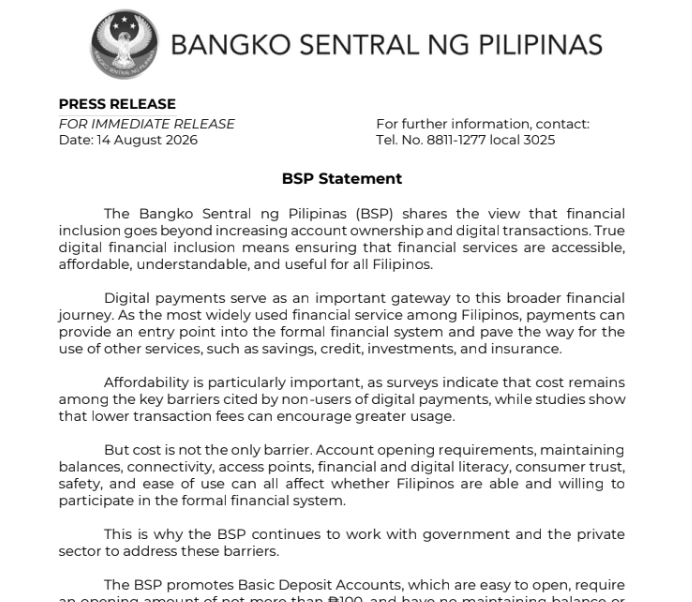
In response, the Bangko Sentral ng Pilipinas (BSP) clarified that true financial inclusion requires tackling both sides of the equation: removing friction and keeping costs manageable.
According to the central bank, digital payments serve as an essential gateway to broader services like savings, credit, insurance, and investments. However, cost and structural friction must be resolved together.
To address onboarding and balance barriers, the BSP pointed to several existing frameworks designed to dismantle traditional obstacles:
| Initiative | Core Function | Target Impact |
| Basic Deposit Accounts (BDAs) | Simplifies account opening with maximum ₱100 opening deposit and zero maintaining balance or dormancy fees. | Eliminates balance penalties for low-income account holders. |
| Paleng-QR Ph Plus | Standardizes QR payment codes for market vendors, drivers, and local merchants. | Enables everyday merchant transactions without card hardware. |
| BELA & Literacy Programs | BSP E-Learning Academy provides digital finance education and safety guidance. | Builds consumer trust and digital familiarity for first-time users. |
The central bank emphasized that account ownership and transaction volumes are not the ultimate end goals. Instead, the broader objective is improving financial health, ensuring Filipinos can withstand financial shocks, access responsible credit, and build long-term security.
What’s Next for Philippine Digital Finance
As the BSP coordinates with government agencies and private sector fintechs under the National Strategy for Financial Inclusion, the focus is turning toward execution. Regulators are encouraging banks, e-wallets, and fintech providers to streamline KYC processes, improve user interfaces, and remove arbitrary account penalties.
This article is published on BitPinas: Is Free Banking Enough If Opening an Account Is Still an Obstacle Course?
What else is happening in Crypto Philippines and beyond:
