
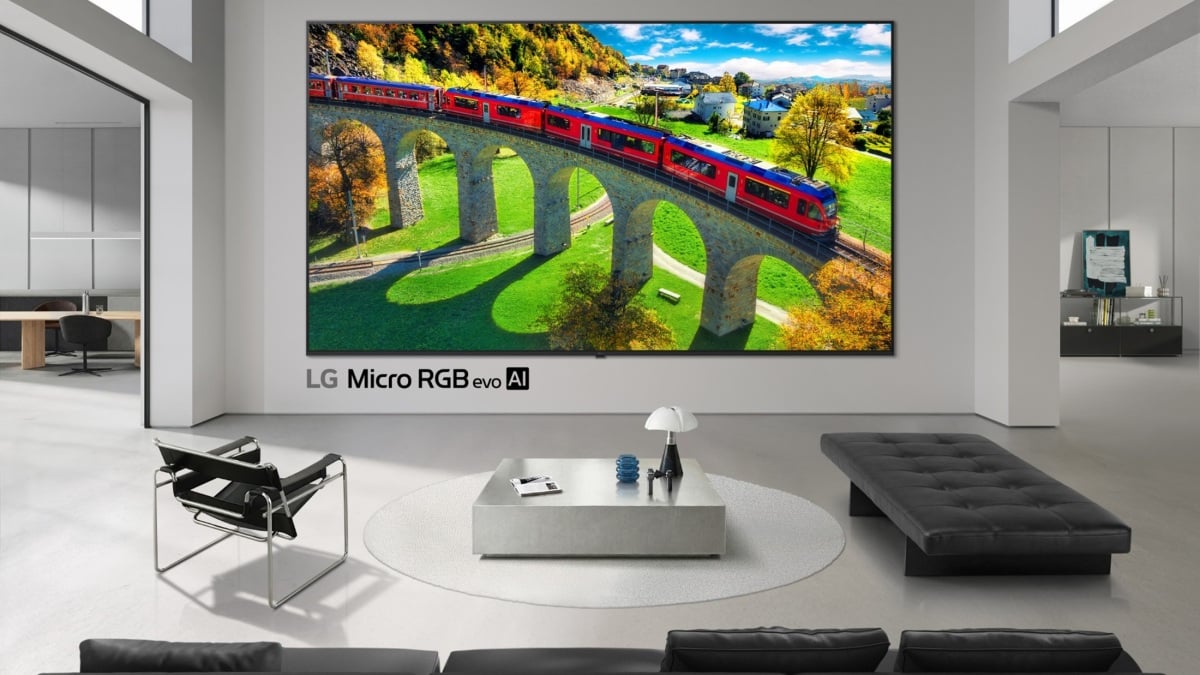
Two TV giants, Samsung and LG, can’t stop talking about their fancy new Micro RGB TVs. But are these TVs truly better than OLEDs, and should you splurge now or wait for the prices to go down? We investigate.
What have Samsung and LG announced?
In mid-December, Samsung and LG front-ran CES 2026 by announcing their new Micro RGB TV sets.
In particular, Samsung said that in 2026 it would expand its Micro RGB TV lineup with 55-, 65-, 75-, 85-, 100- and 115-inch models (the company previously launched a massive, 115-inch TV in 2025).

Samsung’s 115-inch Micro RGB behemoth will be joined by smaller models in 2026.
Credit: Samsung
LG, on the other hand, said it would unveil its first-ever flagship RGB TV at CES 2026. Called the Micro RGB evo, it boasts the smallest individual RGB LEDs ever seen in an LG TV. The company said the TV would be available in 75-, 86-, and 100-inch sizes.
OK, but what are Micro RGB TVs?
These are still LCD TVs, but improved.
Remember when the first LED TVs showed up? Those were displays that used LEDs (light emitting diodes) for backlighting an LCD (liquid-crystal display) panel. The next step in the evolution of LED TVs was mini-LED TVs, which used smaller LED modules to provide backlight to an LCD screen. Smaller is better here, because the mini-LEDs drain less energy and provide more precise illumination, which translates into better picture on your TV.
This leads us to Micro LED TVs, which introduce even smaller LEDs. Again, this means less energy drain, and better picture quality (more on that in a second). But most importantly, these aren’t LCDs, as there’s no LCD panel being backlit with LEDs. Instead, the LEDs themselves create their own light at the pixel level.
And then we have Micro RGB TVs, which are less a name for the technology and more a marketing term that Samsung and LG use to describe a TV with tiny LEDs that, instead of emitting only white or blue light (like those on mini-LED TVs), use LEDs that can emit red, green, or blue light. Despite that, this is still an LCD TV. Think of it as a hybrid solution: The LEDs produce both the backlighting and the colors, but the image is created on an LCD panel.
Mashable Light Speed

Samsung has created this nifty evolution of LED TV panels in one picture.
Credit: Samsung
All of the above compete with OLED (organic light emitting diode) TVs, which work in a different way (and are in fact similar to Micro LED TVs). Instead of using LEDs to illuminate the LCD panel, OLED TVs use pixels that can create their own light and color. The best OLEDs have superior picture quality to most LCD/LED TVs, with deeper blacks and almost infinite contrast, but OLED TVs are pricy to manufacture and tend to degrade over time.
Are these Micro RGB TVs any good?
This is where things get tricky.
Ideally, a Micro LED TV will offer incredibly precise colors, high contrast, and deep blacks — basically the stuff you expect from an OLED TV.
But what Samsung and LG have announced are Micro RGB TVs, and while the name is confusingly similar to Micro LED, it’s not the same thing. (By the way, you can buy a true Samsung Micro LED TV right now, but it will cost you $150,000).
The issue, of course, is that this is not just about making a TV that’s better than OLED. Instead, companies such as Samsung and LG want to make TVs with picture comparable to OLED TVs, but at a more affordable price, and without the drawbacks.
That won’t happen right away. Samsung’s first Micro RGB TV, the 115-inch monster that launched this year, costs $30,000. Smaller models will be cheaper, but we don’t know the exact prices yet.
Finally, these Micro RGB TVs are very new. Few people had a chance to review them, and we just don’t know how they compare to OLEDs or the best LED TVs out there.
No detailed specs yet
There’s a couple of things we can glean from Samsung and LG’s announcements. For example, Samsung says its new Micro RGB TVs will offer “ultra-precise light control and improved color accuracy.” The company also said that these TVs will come with a next-gen AI chipset which will enable “more precise frame-by-frame clarity and realism.”
LG, on the other hand, said its Micro RGB TVs uses “OLED precision to control each of the RGB LED backlights,” and, of course, there’s a next-gen AI improving upscaling as well as overall picture quality. Both companies say their TVs will offer incredibly precise color reproduction.
All that said, we don’t have the exact specs for the upcoming TVs, and we won’t really know how good they are until we see them in person. That will happen at next year’s CES, which takes place in Las Vegas from Jan 6. to 9, so stay tuned for more details.
